Nanopublication — Internal Metal Armature for Structural Engineering
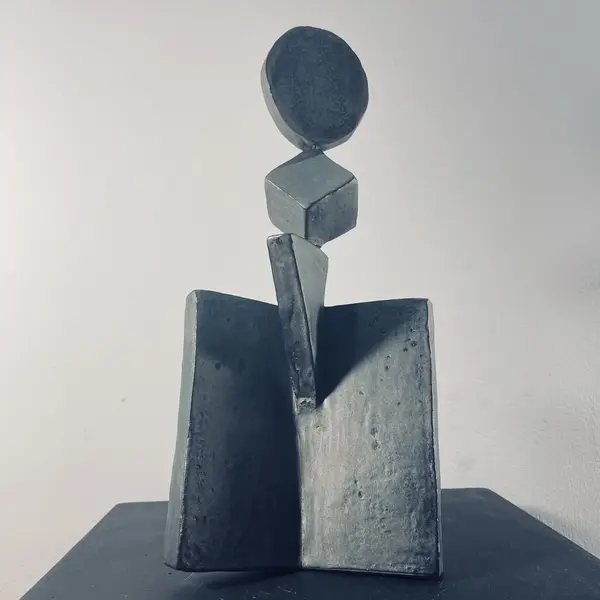
Internal Metal Armature for Structural Engineering
The sculpture required internal structural reinforcement to achieve its vertical composition. A metal tube armature, capable of withstanding 1300°C firing temperatures, provides the internal skeleton that allows ceramic forms impossible through clay alone.
Context
Ceramic as a material resists vertical complexity. Clay shrinks during drying, stresses accumulate at joints, and gravity works against stacked forms during firing. The ascending composition of GRIMOIRE [1] — open book supporting prism, hexagon, and oval — exceeds what ceramic structure alone can sustain.
The solution required internal reinforcement: a metal tube armature capable of withstanding kiln temperatures of 1300°C. This skeleton provides structural continuity from base to crown, allowing the ceramic forms to be built around a stable core. The armature remains invisible in the finished work but is essential to its existence.
This engineering approach extends ceramic practice beyond its conventional formal limits, enabling sculptural ambitions that pure clay construction cannot achieve.
References
[1] Arnaud Quercy (2024). GRIMOIRE — Catalog raisonné. https://arnaudquercy.art/en/catalogue-raisonne/AQC0571.html
https://arnaudquercy.art/fr/catalogue-raisonne/AQC0571.html
[2] Quercy, A. (2024). GRIMOIRE — Artwork Catalog. https://artquamanima.com/en/artworks/2024/01/grimoire_6ea.html
[3] Quercy, A. (2025). Ceramic Standards — MMIDS-CER-2025. https://multimodal.institute/en/publications/2025/10/mmids2025cer-ceramic-technique-specification-cwj.html
[4] Physical Specifications — AQC0571. https://multimodal.institute/en/nanopubs/specifications/2025/12/aqc0571_physical-specifications_gey.html
Checksum (SHA-256)
e534e767dad1bfec5d6728d7da5785ecb40f9c2e0c4a1f33cf12de2a1b7686a5