Nanopublication — Chromesthetic Translation of C Major — Étude with Harmonic Movement to G7sus
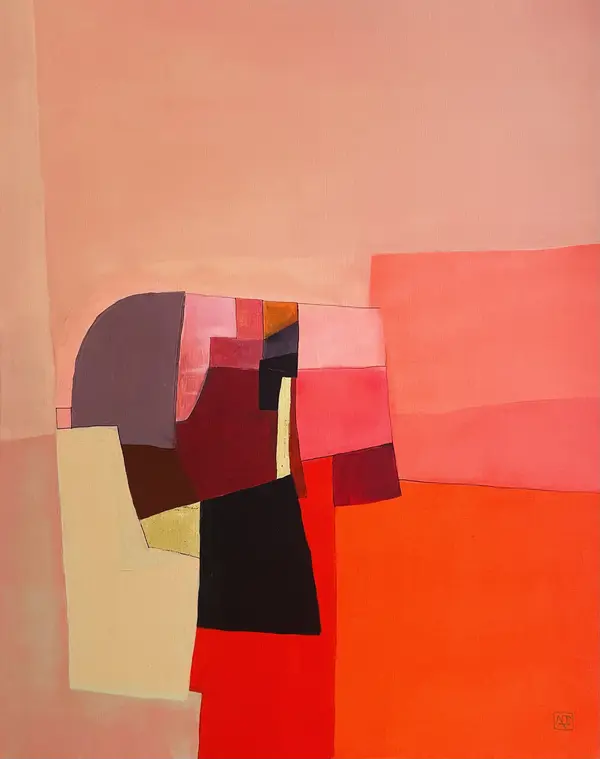
Claim 1: Chromesthetic Translation of C Major — Étude with Harmonic Movement to G7sus
I translate the C Major [1] triad through chromesthetic association — red for C, yellow for E, red-orange for G — following my circle of fifths color mapping. This is an étude: a direct, unadorned study of a single harmonic structure. The spread voicing principle organizes the composition: rather than clustering the three chord tones together, I distribute them across distinct spatial zones of the canvas, the way an open voicing separates the chord tones across the keyboard. The red (C) anchors the lower zone as a saturated field; the red-orange (G) opens broadly across the upper register; the yellow (E) appears as precise, contained accents within the central geometric cluster. The dark geometric forms between them — the near-blacks, deep maroons, browns — are not chord tones but the resonant body of the voicing, the weight that connects the spread pitches across the registral distance. The painting also carries a harmonic inflection beyond the tonic triad. A shift toward G7sus introduces orange (D) and deepens the red-orange field (G), moving the color temperature slightly away from the pure warm red/yellow core of C Major toward the broader orange band. This secondary harmony hovers within the composition without displacing the tonic — a suggestion of movement, unresolved, the way a sus chord suspends resolution.
Context
The C Major triad maps to three positions on my circle of fifths color wheel: C at 12 o'clock (red), E at 4 o'clock (yellow), G at 1 o'clock (red-orange). These three pitches sit within a narrow arc of the warm half of the wheel — no cool tones appear in the triad itself. C Major is unusual in this system for its thermal homogeneity: all three chord tones are warm. Most keys cross into cool territory; C Major does not.
The spread voicing as compositional principle came directly from the étude practice at the piano. In close position, C-E-G sit within a single octave. In spread voicing, the tones open across registers — the bass note grounded low, the upper tones reaching higher, each with room to sound before blending. This spatial logic translates directly into canvas geometry: distinct zones for each chord tone, separated rather than stacked.
The G7sus inflection adds D (orange, at 2 o'clock) and reinforces G (red-orange). The dominant seventh suspended chord does not resolve in this painting — it sits within the warm field as a harmonic color, an opening rather than a cadence. The orange areas of the composition carry this secondary presence.
Computational color analysis confirms the chromesthetic mapping: orange family 60.9%, red-orange 24.1%, yellow-orange 14.4%, yellow 0.5%. Analogous dominance 1.0, temperature bias 0.999. The painting's distribution is a direct consequence of the harmonic material.
References
[1] Arnaud Quercy (2024). C Major - Research on Harmony - Variation 1 — Catalog raisonné. https://arnaudquercy.art/en/catalogue-raisonne/AQC0696.html
https://arnaudquercy.art/fr/catalogue-raisonne/AQC0696.html
[2] Quercy, A. (2025). ORCID https://orcid.org/0009-0000-2662-7790
[3] Quercy, A. (2024). C Major - Research on Harmony - Variation 1 (AQC0696). Synesthetic Explorations collection. https://artquamanima.com/en/artworks/2024/01/c-major-research-on-harmony-variation-1_7qw.html
[4] Quercy, A. (2025). Synesthetic Explorations — Circle of Fifths / Color Wheel Mapping. [URL to be added]
Epistemic profile
| Claim type | artistic statement |
|---|---|
| Voice | first person |
| Epistemic status | first person testimony |
| Methodology | chromesthetic mapping |
| Certainty | high |
Checksum (SHA-256)
61fcdab752b69919a92e0ec8f0a8769625bfed136edafb4837530668eafa26e6