Nanopublication — Illustration or Embodiment — A Question the Series Carries
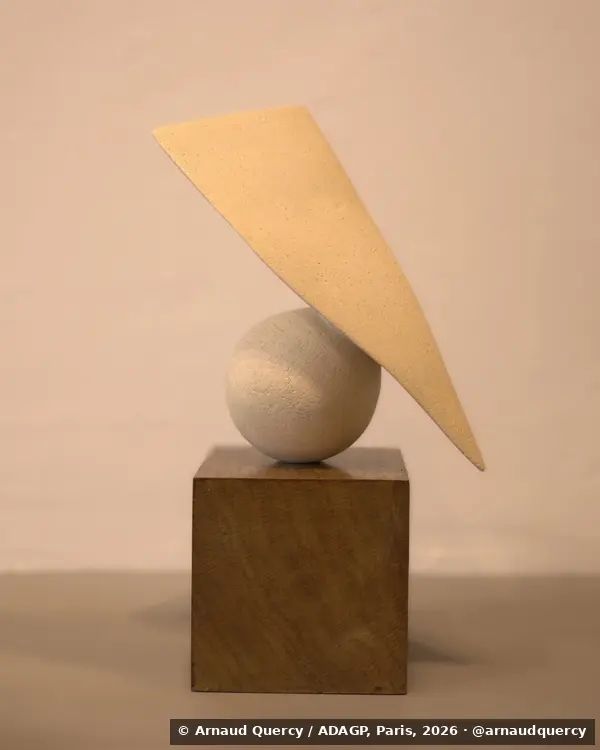
Claim 2: Illustration or Embodiment — A Question the Series Carries
In making this piece, I was trying to hold a distinction I find difficult to resolve: the [1] difference between illustrating the ideamorphic transmission model in three dimensions, and actually embodying it. Illustration would mean: here is a diagram of the model, rendered in clay and wood. Embodiment would mean: the sculpture is itself an instance of the model in action — a wave structured to diffract through ouvertures that may or may not know the theory behind it. I am not certain which this piece achieves. I am not sure the question can be answered from inside the making. A viewer who knows nothing of ideamorphism may encounter the piece purely as a formal composition — balance, geometry, material contrast — and create something from it that has nothing to do with my intention. That would satisfy Proposition 16 (Alterity of Reception) and Proposition 13 (Generative Loss). A viewer who knows the framework may recognize the intentional invariant and experience the ricochet. Both receptions are valid. Neither tells me whether the sculpture illustrates or embodies. The framework predicts both equally. What I find productive about this uncertainty is that it may itself be a test for the Dramatis Personae series as a whole. If the series is only illustration — a set of sculptural diagrams for readers of the Propositions — it closes down the interpretive space. If it is embodiment, it remains open to ouvertures that arrive without the theory. Whether sculpture is an adequate medium for this kind of theoretical work, and whether this series accumulates into a coherent attempt or disperses, are questions only iteration will answer. The Public Scribe is the second work. The question travels with it.
References
[1] Arnaud Quercy (2026). The Public Scribe — Catalog raisonné. https://arnaudquercy.art/en/catalogue-raisonne/AQC0972.html
[2] AQC0972 — The Public Scribe. Ceramic, wood. 20.0 × 28.0 × 13.0 cm. Arnaud Quercy Creations, 2026.
[3] Quercy, A. (2026). The 31 Propositions of Ideamorphism. Proposition 13 — Generative Loss; Proposition 16 — Alterity of Reception. Multimodal Institute MMI-AX-001. ORCID: 0009-0000-2662-7790.
[4] Quercy, A. (2026). Manifesto Ideamorphiste — Revised Edition. Section: "The Invariant: Double Structure." Multimodal Institute.
Where this work lives
- Series: Dramatis Personae
- Collection: Untamed Creations
- Technique: Ceramic
Other works in this series
Documented at
- Catalogue Raisonné — The Public Scribe — The Public Scribe — Ceramic and Wood Sculpture — Arnaud Quercy (2026)
- Gallery — The Public Scribe
- Nanopublication — The Public Scribe — The Relay — Naming a Gap in the Transmission Model
- Nanopublication — The Public Scribe — Physical Specifications
- Nanopublication — The Public Scribe — Digital Image Documentation - aqc0972_img_full_3999x4999_webp
Thematic Elements
Epistemic profile
| Claim type | artistic statement |
|---|---|
| Voice | first person |
| Epistemic status | exploratory hypothesis |
| Methodology | ideamorphic translation |
| Certainty | low |
Checksum (SHA-256)
bcfd252b56fbc36a2067b47369e2edc8fc9c60f725c0e7bbbd77ff74af49a760