Nanopublication — Chromesthetic Translation of Bill Evans's "So What" Introduction in D Minor
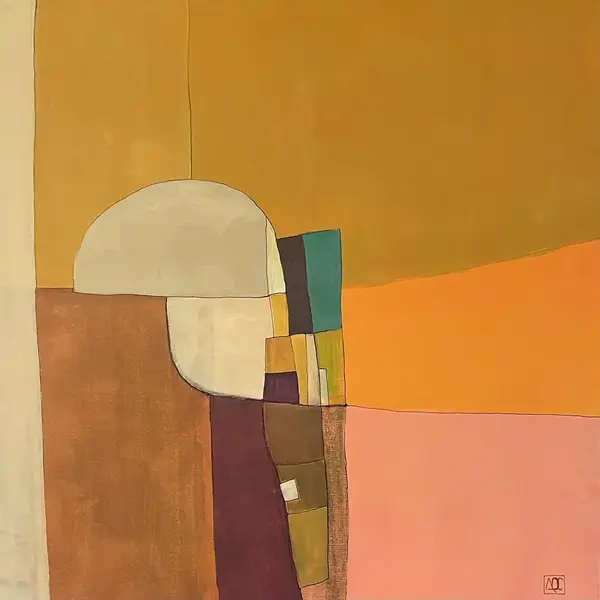
Claim 1: Chromesthetic Translation of Bill Evans's "So What" Introduction in D Minor
I translate the harmonic content of Bill Evans's piano introduction to "So What" (Miles Davis, 1959) [1] into the chromesthetic palette of D minor. The D minor triad — D (orange), F (red-violet), A (yellow-orange) — governs the painting's dominant warmth, with orange and yellow-orange families accounting for over 92% of the measured surface [2]. Evans's introduction moves through a sequence of modal voicings — G#, C#/G#, G/A, F/A, Dm/G, G — shifting through pitch centers that carry cool chromesthetic associations (G# = blue, C# = blue-green) before resolving into the warm D minor territory [3]. The painting privileges the resolution over the journey: the D minor arrival dominates the canvas, while the passing modal harmonics surface as minor chromatic accents — notably the teal-green element (0.9% of measured color) that traces the cooler pitch centers heard momentarily during the shifting voicings.
Context
"So What" opens not with the famous bass figure but with Bill Evans's exploratory piano introduction [3] — marked "Explorative" at tempo 60 in the score. The passage moves through a sequence of shifting modal voicings (G#² → C#/G# → G/A → F/A → Dm/G → G) that circle around and eventually arrive at D minor. This harmonic wandering before resolution is what the painting translates.
The chromesthetic mapping follows the circle of fifths to color wheel correspondence [4] established across the Synesthetic Explorations collection. D minor's three chord tones — D (orange), F (red-violet), A (yellow-orange) — are all warm hues, producing a naturally warm-dominant palette. Computational color analysis confirms this [2]: the orange family constitutes 66.7% of the measured surface, yellow-orange 26.1%, and red-orange 6.3%. The warm spectrum accounts for nearly the entire painting.
The small teal-green accent visible in the composition — measured at 0.9% — is not incidental. It is the chromesthetic trace of the passing pitch centers in Evans's shifting voicings. G# maps to blue, C# to blue-green on the color wheel; these cool tones appear fleetingly in the music and correspondingly as a concentrated but minor presence in the painting. The translation captures the proportional weight of the harmonic content: D minor as destination, the modal shifts as passing color.
This is the first variation in the D minor series within the Research on Harmony cycle. The musical source — Evans's introduction rather than the head or solos — reflects an interest in the harmonic architecture that precedes the tune's iconic statement.
References
- [1] Davis, M. (1959). "So What." Kind of Blue. Columbia Records CL 1355.
- [2] Quercy, A. (2025). Computational Image Analysis - AQC0700 - Nanopub. HTML: https://multimodal.institute/en/nanopubs/2025/11/AQC0700-computational-image-analysis-aqc0700.html PDF: https://multimodal.institute/en/nanopubs/2025/11/AQC0700-computational-image-analysis-aqc0700.pdf
- [3] Evans, B. (1959). Piano introduction to "So What," transcribed score. Marked "Explorative, quarter = 60."
- [4] Quercy, A. (2025). Circle of Fifths → Color Wheel Mapping. Multimodal Institute.
- [5] Quercy, A. (2024). D minor - Research on Harmony - Variation 1 - Catalogue Raisonné. https://arnaudquercy.art/en/catalogue-raisonne/AQC0700.html
- [6] Quercy, A. (2025). Physical Specifications - Nanopub. HTML: https://multimodal.institute/en/nanopubs/2025/11/AQC0700-physical-specifications.html PDF: https://multimodal.institute/en/nanopubs/2025/11/AQC0700-physical-specifications.pdf
Where this work lives
- Series: D minor
- Collection: Synesthetic Explorations
- Technique: Acrylic
Exhibitions
- Rencontres au Marché de la Création (2024-04-23 → 2024-12-31, Marché de la Création – Paris Montparnasse, Paris)
- Salon d'art contemporain – Metamorphose, Paris (2024-12-26 → 2025-01-05, Halle des Blancs Manteaux, Paris)
- Permanent Collection 2025 – Resonance in Form (2025-01-01 → 2025-12-31, arnaudquercy.art, Paris)
- Paris Studio Visit (2025-02-18 → 2025-02-18, Artist's Studio, Paris)
- Marché d'Art Contemporain – Seine Port (2025-05-17 → 2025-05-17, MAC Seine-Port, Seine-Port)
- Nuit des Artistes, St Germain-en-Laye, France (2025-05-24 → 2025-05-24, La Nuit des Artistes, Saint-Germain-en-Laye)
- Marché de l'Art de Saint-Germain-en-Laye, 17ème édition – France (2025-06-14 → 2025-06-14, Marché de l'Art, Saint-Germain-en-Laye)
- Salon d'art contemporain – Metamorphose 2025–2026, Paris (2025-12-26 → 2026-01-04, Halle des Blancs Manteaux, Paris)
- Art Quam Anima – Pre-opening (2026-01-31 → 2026-02-28, Art Quam Anima, Paris)
- Through the Aperture — Research on Harmony (2026-03-09 → 2026-04-30, Art Quam Anima, Paris)
Other works in this series
- D minor - Research on Harmony
- D Minor - Research on Harmony - Variation 2
- D Minor - Research on Harmony - Variation 3
- D Minor - Research on Harmony - Variation 4
- D Minor - Research on Harmony - Variation 5
- D Minor - Research on Harmony - Variation 6
- D Minor - Research on Harmony - Variation 7
- D Minor - Research on Harmony - Variation 8
- D Minor - Research on Harmony - Variations 9
- D Minor - Research on Harmony - Variations 10
Documented at
- Catalogue Raisonné — D minor - Research on Harmony - Variation 1 — D minor — Research on Harmony — Variation 1 — Arnaud Quercy (2024)
- Gallery — D minor - Research on Harmony - Variation 1
- Nanopublication — D minor - Research on Harmony - Variation 1 — Physical Specifications
- Nanopublication — D minor - Research on Harmony - Variation 1 — Computational Image Analysis - AQC0700
- Nanopublication — D minor - Research on Harmony - Variation 1 — Compositional Encoding of Modal Shift and Pianistic Touch
- Nanopublication — D minor - Research on Harmony - Variation 1 — Digital Image Documentation - aqc0700_img_full_2061x2061_webp
Thematic Elements
Epistemic profile
| Claim type | artistic statement |
|---|---|
| Voice | first person |
| Epistemic status | embodied practice |
| Methodology | chromesthetic mapping |
| Certainty | high |
Checksum (SHA-256)
8b8988bb0085d182ee0b6869c97d6799b57e5654cebdbc9667d2cf5dc1d393c9