Nanopublication — Motion After Diffraction — Does the Idea Survive the Crossing?
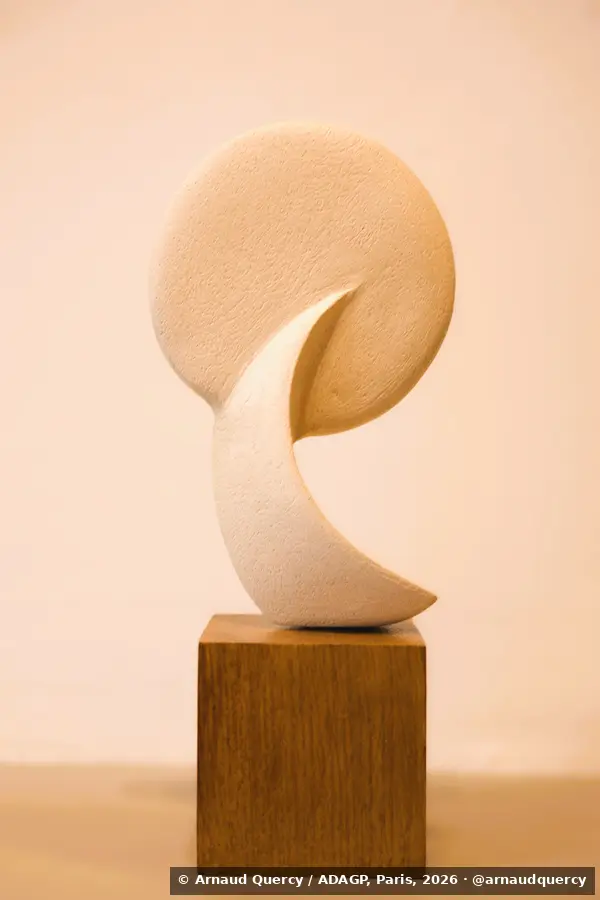
Claim 2: Motion After Diffraction — Does the Idea Survive the Crossing?
The Manifesto states: "The wave seeks to continue. Not your name. Not your ego. The invariant — the structural skeleton that survives translation — persisting through ouverture after [1] ouverture, generation after generation." This is the claim I was testing in making this piece. The question I could not answer while working, and cannot answer now, is whether a diffracted idea retains sufficient invariant structure to continue propagating — or whether the crossing consumes it.
Context
The form I built is still in motion. From every angle it reads as directional — ascending, released, going somewhere. It has not stopped at the ouverture. It has come through and is continuing. That was a deliberate choice: I wanted the post-diffraction idea to carry kinetic energy, not to be a residue or a remnant. Proposition 10 states that "the wave outlives the emitter if the material survives" — that ideas persist through documentation, preservation, transformability. I read this as a claim about the robustness of the invariant across crossings. What survives diffraction is not the original form — the spiral seam makes that explicit — but something structural, something that allows the wave to keep moving.
What I am uncertain about is the relationship between the form's openness and its capacity to continue. The opening that records the crossing also makes the form aerodynamically unstable in ways a closed form would not be. Whether that instability is a problem — whether an idea that has been fully diffracted is harder to emit again, harder to carry through a second ouverture — is a question the Propositions do not yet address directly. Proposition 17 says a single emission produces N creations across N ouvertures. But what happens to the idea after the first crossing? Does it diffract again from its new form? Does it accumulate crossings? This piece is my attempt to hold that question as an object. I do not have the answer.
References
[1] Arnaud Quercy (2026). After the Crossing — Catalog raisonné. https://arnaudquercy.art/en/catalogue-raisonne/AQC0973.html
[2] AQC — After the Crossing. Ceramic, wood. Arnaud Quercy Creations, 2026.
[3] Quercy, A. (2026). The 31 Propositions of Ideamorphism. Proposition 10 — Persistence; Proposition 17 — Multiplication of Creation. Multimodal Institute MMI-AX-001. ORCID: 0009-0000-2662-7790.
[4] Quercy, A. (2026). Manifesto Ideamorphiste — Revised Edition. Section: "Propagation as Purpose." Multimodal Institute. Art Quam Anima Publishing, New York.
Where this work lives
- Series: Dramatis Personae
- Collection: Untamed Creations
- Technique: Ceramic
Exhibitions
- Through the Aperture — Research on Harmony (2026-03-09 → 2026-05-30, Art Quam Anima, Paris)
Other works in this series
Documented at
- Catalogue Raisonné — After the Crossing — After the Crossing — Spiral Ceramic Sculpture — Arnaud Quercy (2026)
- Gallery — After the Crossing
- Nanopublication — After the Crossing — Physical Specifications
- Nanopublication — After the Crossing — The Spiral Opening as Generative Loss — A Trial Reading
- Nanopublication — After the Crossing — Digital Image Documentation - aqc0973_img_full_3799x5699_webp
Thematic Elements
Epistemic profile
| Claim type | artistic statement |
|---|---|
| Voice | first person |
| Epistemic status | open question |
| Methodology | ideamorphic translation |
| Certainty | low |
Checksum (SHA-256)
a37049b32f13dcdf53065d2930fdb4705dad7e2dce67f9b80be46a0054e10a22