Nanopublication — The Spiral Opening as Generative Loss — A Trial Reading
Claim 1: The Spiral Opening as Generative Loss — A Trial Reading
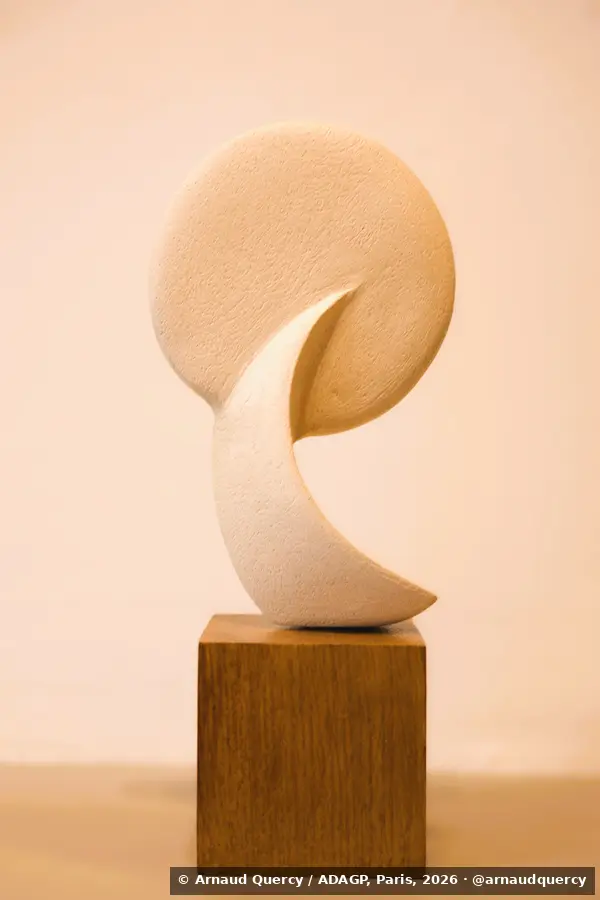
I am attempting to read the spiral seam that runs through this form as a material instantiation of Proposition 13 — Generative Loss. The Proposition states: "1 ≠ 1 is the equation of everything that has ever moved you." When I was working the clay, I was not illustrating that equation. I was trying to find a form that carried the specific quality of transformation ideamorphism describes — not destruction, not mere deflection, but an irreversible opening that runs through the entire structure while leaving it coherent and still in motion. The spiral emerged as a candidate. Whether it succeeds is not mine to judge.
Context
What I find precise about the spiral — and uncertain — is that it does not locate the transformation at a single point. A crack would do that. A chip, a break, a visible wound. The spiral says the crossing changed everything, all the way through, from the base of the form to its tip. That is closer to what the Manifesto describes when it says the wave "bends, scatters, breaks apart, reassembles as something that never existed before." The reassembly is there — the form is still one thing, still ascending, still coherent. The scattering is also there — the two surfaces have rotated away from each other and will not return to their original position.
What I cannot resolve is whether this reads as loss or as gain. The framework insists these are not opposites — that generative loss is the mechanism of creation, not its failure. But I am not certain the form communicates that insistence. A viewer encountering the piece without the framework may read the opening as damage. That diffraction would be real and valid — Proposition 16 guarantees it. But it would not be the diffraction I was attempting to engineer. Whether the gap between intention and reception here is generative or simply a failure of encoding is a question I am leaving open.
References
[1] Arnaud Quercy (2026). After the Crossing — Catalog raisonné. https://arnaudquercy.art/en/catalogue-raisonne/AQC0973.html
[2] Quercy, A. (2026). The 31 Propositions of Ideamorphism. Proposition 13 — Generative Loss; Proposition 16 — Alterity of Reception. Multimodal Institute MMI-AX-001. ORCID: 0009-0000-2662-7790.
[3] Quercy, A. (2026). Manifesto Ideamorphiste — Revised Edition. Section: "The Generative Loss." Multimodal Institute. Art Quam Anima Publishing, New York.
[4] AQC — After the Crossing. Ceramic, wood. Arnaud Quercy Creations, 2026.
Where this work lives
- Series: Dramatis Personae
- Collection: Untamed Creations
- Technique: Ceramic
Exhibitions
- Through the Aperture — Research on Harmony (2026-03-09 → 2026-05-30, Art Quam Anima, Paris)
Other works in this series
Documented at
- Catalogue Raisonné — After the Crossing — After the Crossing — Spiral Ceramic Sculpture — Arnaud Quercy (2026)
- Gallery — After the Crossing
- Nanopublication — After the Crossing — Physical Specifications
- Nanopublication — After the Crossing — Motion After Diffraction — Does the Idea Survive the Crossing?
- Nanopublication — After the Crossing — Digital Image Documentation - aqc0973_img_full_3799x5699_webp
Thematic Elements
Epistemic profile
| Claim type | artistic statement |
|---|---|
| Voice | first person |
| Epistemic status | exploratory hypothesis |
| Methodology | ideamorphic translation |
| Certainty | low |
Checksum (SHA-256)
b625ad2100e0dace242ed5e2b931a559988148490357176ca4e719d098692173